René Walther
1928–2025 · Slender-deck cable-stayed bridges (Diepoldsau, 1985); concrete teaching at EPFL
A Swiss engineer and professor, René Walther advanced slender-deck cable-stayed bridges and trained a generation of engineers at the Swiss Federal Institute of Technology in Lausanne.
Biography
Born on 8 March 1928 in Basel, René Walther graduated in engineering from the Swiss Federal Institute of Technology in Zurich in 1952, then earned a doctorate at Lehigh University in the United States in 1957. He then worked for Losinger in Bern.
As a professor, he led the institute of reinforced and prestressed concrete at the Swiss Federal Institute of Technology in Lausanne, and from 1963 ran a design office in Basel with Hans Mory. From 1989 he edited the EPFL Treatise on Civil Engineering series. He died in early May 2025.
He received the Fritz Leonhardt Prize in 2005.
What he invented or proved
Walther studied and built cable-stayed bridges with very slender decks, hung from many closely spaced stays: the deck hardly acts as a beam any more, which lightens it considerably. His book on cable-stayed bridges, written with his colleagues, is a reference.
He also worked on prestressed concrete and its design rules.
His works
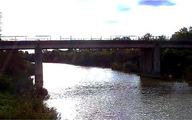
- Diepoldsau Bridge (1985), over the Rhine: a slender-deck cable-stayed bridge.
- Cable Stayed Bridges (1985), with B. Houriet, W. Isler and P. Moïa.
- Construire en béton (1993).
- Cardboard tower of the Swiss pavilion at the Seville Universal Exposition (1992).
What we owe René Walther
Closely spaced stays, slender deck, stay-force adjustment: his work is among the foundations on which we assess and monitor cable-stayed bridges.
Sources
- Dictionnaire historique de la Suisse, « Walther, René »
- Structurae, fiche « René Walther »
- R. Walther et al., « Ponts haubanés » (Presses polytechniques romandes, 1985)
- Beton- und Stahlbetonbau, « Fritz-Leonhardt-Preis für René Walther » (2006)
Tester mes connaissances sur les grands bâtisseurs
See also
In our projects
A few structures of the same type studied by THEOREMS.