Theodore von Kármán
1881–1963 · Vortex street (1911); bridge aerodynamics after Tacoma (1940)
A Hungarian-born engineer and physicist, Theodore von Kármán explained the alternating vortices that make structures vibrate in the wind, and took part in the inquiry into the Tacoma Narrows Bridge collapse.
Biography
Born on 11 May 1881 in Budapest, Theodore von Kármán studied in Budapest and then earned his doctorate in Göttingen under Ludwig Prandtl. A professor in Aachen, in 1930 he left to direct the aeronautical laboratory at the California Institute of Technology.
He co-founded the Jet Propulsion Laboratory and in 1962 received the first US National Medal of Science. He died in Aachen on 6 May 1963.
What he invented or proved
In 1911 von Kármán described the street of vortices shed alternately on either side of an obstacle in a flow: it creates periodic forces able to make chimneys, cables and decks oscillate.
A member of the board of inquiry into the Tacoma Narrows Bridge, destroyed by wind in 1940, he helped bring aerodynamics into suspension bridge design.
His work
- Kármán vortex street (1911).
- Inquiry into the collapse of the Tacoma Narrows Bridge (1940–1941).
- Mathematical Methods in Engineering (1940), with Maurice Biot.
What we owe Theodore von Kármán
Vortex shedding on stays, hangers and light decks: we check its effects in our footbridge and cable-structure studies.
Sources
- California Institute of Technology, « Theodore von Kármán »
- National Academy of Sciences, Biographical Memoirs, « Theodore von Kármán »
- O. H. Ammann, T. von Kármán, G. B. Woodruff, « The Failure of the Tacoma Narrows Bridge » (1941)
Tester mes connaissances sur les grands bâtisseurs
See also
In our projects
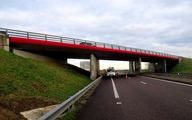
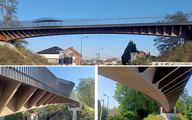
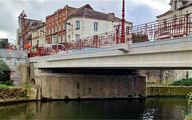
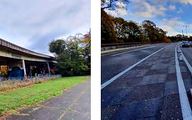
A few structures of the same type studied by THEOREMS.